
In a 7% Market, Home Builders Are Selling Stability
There’s some supposedly sage advice that says "marry the house, date the rate." The idea is to buy the home you love now and refinance when rates drop. This is the type of thinking that gets good people into bad marriages. Nobody can promise rates will drop, so I'd rather my buyers start with a rate they'd be happy to keep.
For most buyers who don't already have a low rate to protect, including renters and first-time buyers, purchasing a newly built home is the best answer to the high interest rates we’re currently enduring. Builders have a tool resale sellers can't match at the same scale, the rate buydown, and it comes in a few different forms. Some are worth a lot more than others, so it helps to know which one you're being offered
Freddie Mac reported the average 30-year fixed rate at 7.28% on October 1, the highest it's been since November 2023. Builders know a high rate keeps buyers on the sidelines, so many of them are paying to bring it down.
The National Association of Home Builders found that 66% of builders used sales incentives in September, the highest share since last December. Rate buydowns are one of the most common. A resale seller can offer a credit toward your rate too, but builders usually have far more room to do it, and some have programs a single homeowner can't access at all.
A temporary buydown gives you a lower rate for the first one to three years, then steps up to the full rate for the rest of the loan. The most common version is called a 2-1. On a 7% loan, you'd pay as if the rate were 5% in year one, 6% in year two, and 7% from year three on. A 3-2-1 works the same way over three years, starting three points below the full rate.
That breathing room is real, and it helps if you're settling into a new home, covering moving costs or furnishing empty rooms. Just plan your budget around the payment after the buydown ends, since that's the one you'll live with for the long haul.
A permanent buydown lowers your rate for the entire loan. The builder pays an upfront fee to your lender, and in exchange your rate drops and stays there. There's no step-up later and no refinance to plan around. On a 30-year fixed loan, the rate on day one is the rate in year thirty.
Many larger builders reserve a block of below-market rates with a lender in advance, then offer those rates to their buyers. You'll see them advertised as a specific number, often well under what the rest of the market is paying.
It works like a permanent buydown, only at scale, because the builder is buying in bulk. A homeowner selling one house can't set this up. And because the rate is fixed for the life of the loan, it's the kind of rate you can keep for good.
One caveat on price range. These programs usually run on standard-size loans, so higher-priced homes that need a larger jumbo loan often fall outside them. Outside the luxury end of the market, though, this is the strongest incentive I see builders offer.
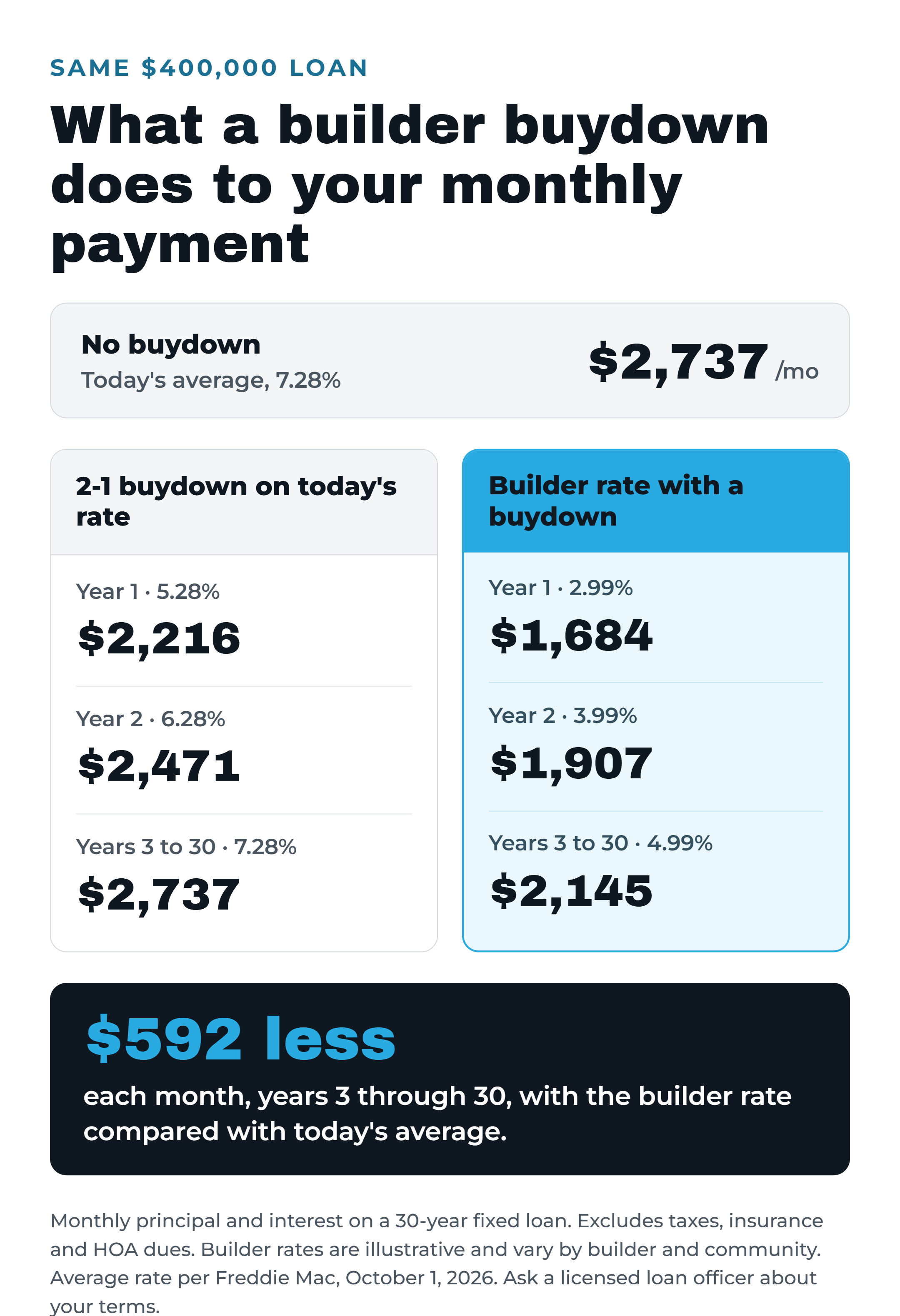
Take a $400,000 loan as an example. The builder rates are for illustration only. Rates and buydown terms vary by builder and by community, sometimes even by home, and they change often, so ask for the current terms on any home you're considering.
The temporary buydown on today's rate saves money early, then lands right back at the market payment. The builder offer starts lower still, and once it settles at 4.99% in year three, it saves roughly $590 a month against today's average for the rest of the loan. These figures leave out property taxes, insurance and HOA dues, so your full payment will be higher.
The best rates usually come through the builder's own lender. That's normal in new construction. You can still get a quote from another lender to compare, and you should.
The lowest advertised rates are often tied to homes that are already built or close to finished, with a set window to close. If you're building from the ground up, ask what rate will be available when your home is ready.
The buydown isn't free. Builders set their prices knowing which incentives they'll offer, so part of the cost of that lower rate is usually built into what you pay for the home. Even so, the bottom line is the monthly payment, and a lower rate for the life of the loan typically saves you more each month than a modest bump in price adds.
A buydown and a price cut aren't the same thing. A lower rate shrinks your monthly payment, while a lower price shrinks what you owe. Sometimes a builder will let you choose, and the right answer depends on how long you plan to stay. For buyers planning to put down roots, the rate is usually where I'd look first, and a lender can run both options side by side.
My own feeling is, with rates where they are a builder-backed rate that lasts the life of the loan is one of the best deals in the industry right now, at least outside the luxury price range. It turns a new home from something you hope to refinance into something you can keep. You get the house and a rate you won't need to break up with.
Every buyer's numbers are different, so talk to a licensed loan officer about what you qualify for. If you're curious which Valley builders are offering what right now, I'm glad to walk you through it.
Sources