
Valley Market Analysis
September 2026
A home in Paradise Valley and a home in Goodyear are sitting in two very different housing markets right now, in the same metro, in the same month.
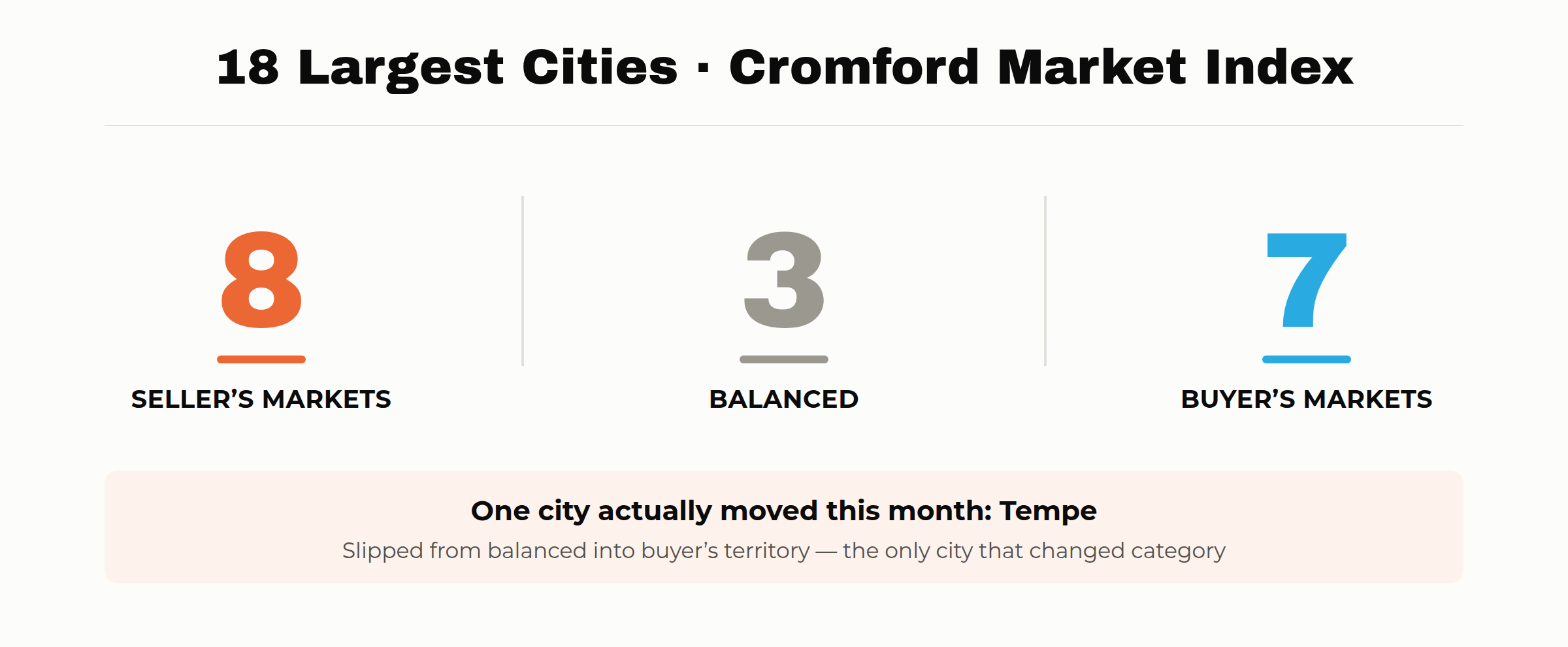
According to The Cromford Report's Cromford Market Index, built from data licensed through the Arizona Regional Multiple Listing Service (ARMLS), the Valley's 18 largest cities split into eight seller's markets, three balanced markets, and seven buyer's markets as of September 3. A month earlier, the count was eight seller's, four balanced, six buyer's. Almost nothing changed.
Almost. One city crossed a line: Tempe. It slipped from a balanced market (CMI 92.0) to a buyer's market (88.3) over the past month, the only city on the list that changed classification at all.
The rest of the picture held. Paradise Valley, Fountain Hills, Scottsdale, and Cave Creek are still the steepest seller's markets in the Valley, and still climbing. Paradise Valley's index rose another 13% in the past month alone, to 207.8, the highest reading on the list by a wide margin. Cromford's own explanation hasn't changed either: strong demand at the high end, combined with sellers pulling listings for the summer, thins out the competition for what's still on the market.

Chandler, Mesa, Phoenix, and Glendale are also seller's markets, but only barely, all sitting between 111 and 139 on Cromford's scale, where anything over 110 counts. They don't share one region or one explanation the way the four cities above do. Gilbert and Avondale sit just below that line, in Cromford's balanced zone, and Peoria is right at the other edge of balanced, close enough to buyer's territory that it's worth watching next month.
Buyer's markets, meanwhile, mean largely what they meant a month ago: Goodyear, Surprise, San Tan Valley, Maricopa, Queen Creek, and Buckeye, all still well under Cromford's buyer's-market threshold. Tempe now joins that list, which matters more than the other six, since Tempe isn't an outer-ring suburb. It's a large, central, well established city, and its shift into buyer's territory is a genuinely new data point, not just one more confirmation of what the West Valley and Pinal County have looked like for months.
What this means if you're buying
In Paradise Valley, Fountain Hills, Scottsdale, or Cave Creek, expect the same tight competition you'd have found a month ago, if not tighter. In Chandler, Mesa, Phoenix, or Glendale, the market favors sellers, but only slightly, so a well-prepared offer still has real leverage. In Tempe, Goodyear, or the other buyer's-market cities, you're negotiating from a stronger position than you were a month ago, and in Tempe's case, a stronger position than you'd have had at any point this summer.
What this means if you're selling
If you're in one of the four steep seller's markets, the data still supports pricing with confidence. In the more modest seller's-market cities, price to the data rather than to the headline, since the advantage there is real but thin. If you're in Tempe, treat this month's numbers as a signal to revisit pricing and preparation before listing, not after.
The bigger picture
Most of the Valley's largest cities haven't changed category in a month. The cities to watch are the ones sitting closest to a threshold right now, Gilbert and Avondale on the seller's side, Peoria on the buyer's side, since that's where the next real move, if there is one, will show up first.
If you want a read on what's happening in your city or zip code, I'm happy to pull it for you. No pressure, just the numbers.